

Super Fresh
Harvested and shipped within days when you order.
Fair Prices
We eliminate extra steps so you get better value.
Rated for Real Life
Clearly labeled so you can choose the right plant fast.
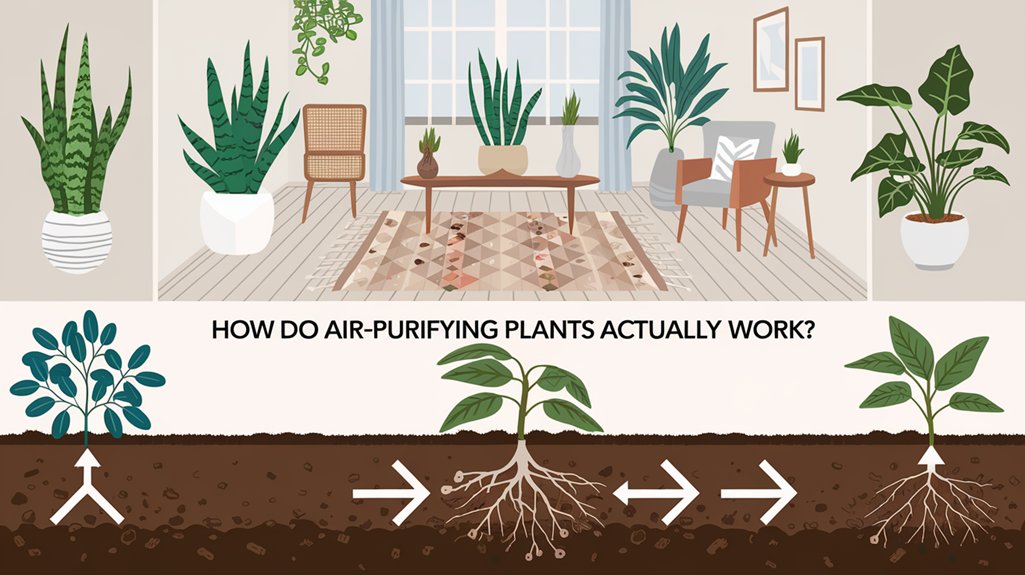
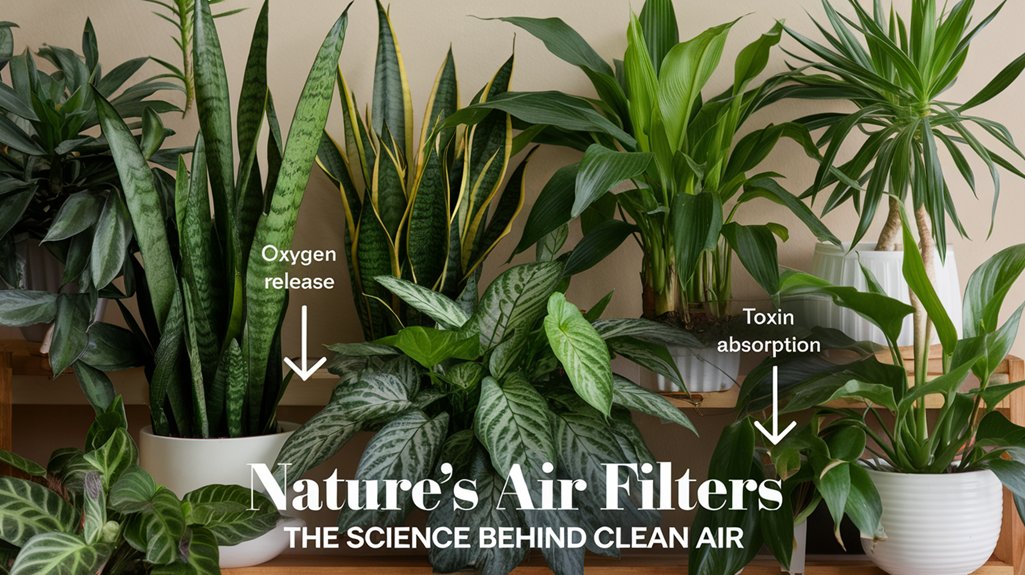
Air-purifying plants cleanse your indoor air through phytoremediation, a process where they absorb volatile organic compounds (VOCs) and pollutants via leaves and roots. Soil microorganisms aid in breaking down these toxins, while plants release oxygen which enriches the air. Although effective, a significant number of plants are needed for notable results. Mechanical systems like HEPA filters are more efficient. Exploring more, you’ll find psychological and aesthetic benefits that houseplants offer beyond air purification.
When you explore the science behind air-purifying plants, it becomes clear that these natural wonders rely on a process known as phytoremediation.
Through this process, plants purify indoor air by absorbing pollutants through their leaves and roots. They effectively clean the air by converting harmful substances into less toxic forms.
Air-purifying plants, like the snake plant and peace lily, target indoor air pollutants, specifically volatile organic compounds (VOCs) such as benzene and formaldehyde. These compounds are prevalent in many household products.
Research demonstrates that these plants can reduce airborne molds and bacteria by 50-60%, enhancing indoor air quality.
While individual plants have limited capabilities, combining them with proper ventilation greatly boosts their effectiveness in purifying the air.
Understanding the role of air-purifying plants extends beyond their ability to remove toxins; it’s imperative to contemplate their contribution through photosynthesis and oxygen production. Indoor plants engage in photosynthesis by absorbing carbon dioxide and water, utilizing sunlight to produce glucose and oxygen. This oxygen production is essential for maintaining clean air in enclosed spaces.
Although often overlooked, the role of air-purifying plants in absorbing volatile organic compounds (VOCs) like benzene and formaldehyde is a critical component of indoor air quality improvement.
These plants purify the air by absorbing VOCs through their leaves and roots during photosynthesis. Stomata, tiny openings on leaves, facilitate the absorption of these compounds, allowing gases to enter and exit efficiently.
Research shows that a substantial number of plants, ranging from 10 to 1,000 per square meter, is necessary to achieve significant VOC reduction indoors. While potted plants can convert toxins into less harmful substances, their real-world efficacy is limited compared to mechanical filtration systems.
Nonetheless, integrating plants into indoor environments can offer a natural, supplementary purification method.
While often overlooked, soil microorganisms are essential allies in the quest for improved air quality indoors. These tiny organisms excel at breaking down volatile organic compounds (VOCs) and other pollutants through biodegradation, converting them into less harmful substances.
By supporting the roots, they enhance the air purification process, allowing plants to absorb more contaminants effectively. Research highlights the advantages these microorganisms provide, proving their critical role in environmental detoxification through phytoremediation.
In addition to the significant role soil microorganisms play in air purification, plants themselves contribute directly to enhancing indoor air quality through the process of transpiration.
Transpiration involves the release of water vapor from plant leaves, which increases humidity in indoor environments. As plants absorb water from the soil, it evaporates through stomata, cooling the surrounding air.
This increased humidity can help regulate indoor conditions, making them more comfortable, particularly in dry environments. By elevating humidity levels, transpiration can reduce airborne dust and particulates, thereby improving air quality.
Studies highlight that environments with plants can have 50-60% fewer airborne molds and bacteria, partly due to transpiration’s humidifying effects, offering a natural solution to maintaining healthier indoor spaces.
When seeking effective air-purifying plants, it’s essential to take into account certain key characteristics that enhance their ability to improve indoor air quality.
These plants efficiently remove volatile organic compounds (VOCs) and other toxins through several mechanisms:
Exploring popular air-purifying plants reveals a range of options that actively enhance indoor air quality through various mechanisms.
Snake plants, known for their resilience, efficiently remove indoor air pollutants like formaldehyde and benzene, even in low light conditions.
Peace lilies offer the benefits of indoor plants by reducing mold spores and VOCs, though they require pet safety considerations.
Spider plants, thriving in indirect sunlight, are effective at eliminating carbon monoxide and formaldehyde, making them ideal houseplants for pet owners.
Boston ferns excel at increasing humidity and filtering pollutants, but they demand high moisture.
Pothos plants, versatile in care, are adept at reducing VOCs, but their toxicity necessitates careful placement away from pets.
Each plant presents unique air-purifying benefits.
Though houseplants are often celebrated for their air-purifying capabilities, their effectiveness in improving indoor air quality comes with notable limitations.
Contrary to popular belief, a significant number of plants are required to noticeably reduce volatile organic compounds (VOCs) indoors. Here’s what you should consider:
These factors highlight the limitations of relying solely on houseplants for air purification.
While houseplants offer some air-purifying benefits through phytoremediation, their impact pales in comparison to mechanical air purification systems.
Plants help by reducing indoor air pollutants, including volatile organic compounds (VOCs), but require an impractical density of 10-1,000 plants per square meter for significant effect.
In contrast, mechanical systems like HEPA filters efficiently remove 99.97% of airborne particulates, providing a more effective solution for indoor air quality.
Studies show that plant effectiveness is often constrained to controlled environments, unlike the consistent performance of mechanical systems in typical indoor settings.
Although genetic modifications aim to bolster plants’ air-cleaning capabilities, they still fall short.
Ultimately, mechanical air purification systems remain superior in reducing pollutants in the air.
Despite the superior air purification capabilities of mechanical systems, houseplants offer unique psychological and aesthetic benefits that technology can’t replicate.
Indoor plants can considerably enhance your mood and creativity. Studies show that they boost productivity and well-being in workspaces. The WELL Building Standard recommends covering at least 1% of indoor surface area with plants to maximize psychological benefits and promote calm.
Embrace indoor plants for their myriad benefits beyond just air quality.
You’ve explored how air-purifying plants enhance indoor air quality through photosynthesis, VOC absorption, and soil microorganisms. While these plants regulate humidity and provide psychological benefits, their impact on air purification is limited compared to mechanical methods. Scientific evidence suggests that incorporating these plants into your environment offers aesthetic and mental health advantages, though they shouldn’t replace advanced air filtration systems. Ultimately, houseplants complement other purification strategies, creating a healthier, more pleasant living space.