

Super Fresh
Harvested and shipped within days when you order.
Fair Prices
We eliminate extra steps so you get better value.
Rated for Real Life
Clearly labeled so you can choose the right plant fast.
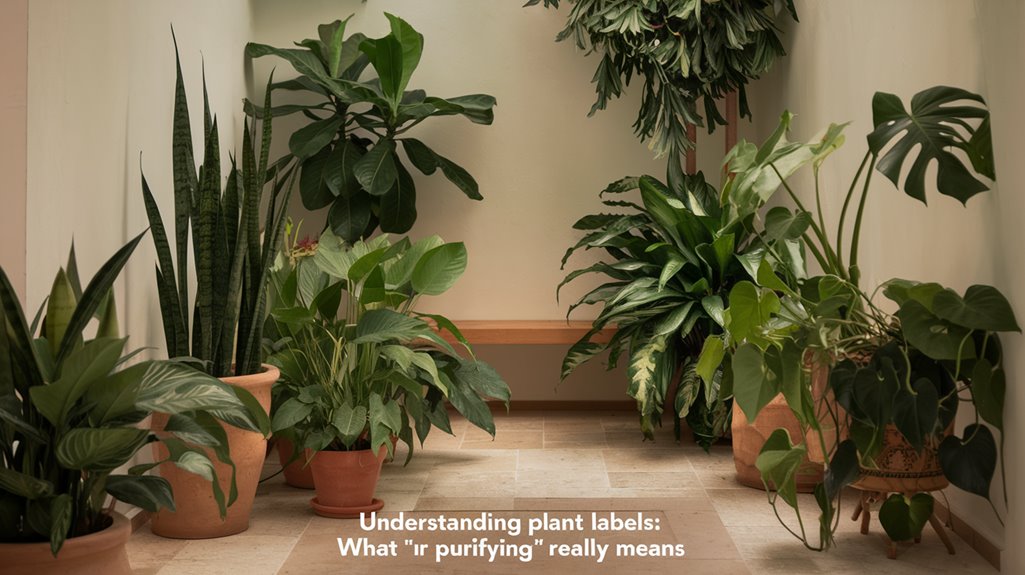
When you see “air purifying” on plant labels, it’s primarily a marketing term. Scientific research shows that even though houseplants can absorb some VOCs, their impact on air quality is minimal under real-world conditions. You’d need a high density of plants for a noticeable effect, which isn’t practical. Instead, focus on mechanical air purifiers and better ventilation. Indoor plants do offer psychological benefits and aesthetics, which you’ve learn more about in the following sections.
While the allure of houseplants as natural air purifiers is enticing, it’s essential to understand the limitations outlined by scientific research.
Air purifying plants are often marketed as solutions to improve indoor air quality by removing volatile organic compounds (VOCs). However, recent studies reveal that this is largely a myth.
The NASA study’s controlled conditions don’t reflect real-world environments, where plants’ VOC removal is negligible. You’d need an impractical number of plants—about 10 per square foot—to achieve noticeable effects.
Consequently, relying on houseplants alone won’t enhance air quality. Instead, experts recommend mechanical air purification systems and improved ventilation, emphasizing these methods as more effective for addressing indoor air pollution and maintaining a healthier living environment.
Turning attention to the NASA Clean Air Study, which has become a cornerstone in the discussion of plants and indoor air quality, it’s necessary to critically examine its findings.
The original research, conducted in 1989, suggested that houseplants could purify air by removing VOCs. However, it was done in sealed chambers, far from real-world conditions.
Debunking this, subsequent studies, like one from Drexel University, revealed houseplants have minimal impact on indoor air quality. You’d need 10 to 100 plants per square meter for significant VOC reduction—impractical for typical spaces.
Even NASA’s own Gioia Massa acknowledged flaws in the study. Despite this, the misconception persists, fueled by marketing and misinterpretation of the NASA study’s air purifying claims.
Although houseplants are often touted for their air-purifying abilities, the reality of phytoremediation indoors presents considerable limitations. Indoor plants absorb volatile organic compounds (VOCs) at a slow rate, making them inefficient air purifiers. A famous 1989 NASA study suggested plants could improve air quality; however, achieving clean air would require an impractical density of plants—around 10 per square foot.
| Factor | Plant Efficiency | Alternative Solution |
|---|---|---|
| VOC Absorption Rate | Low | Natural Ventilation |
| Plant Density Needed | High (10/sq. ft.) | Air Filtration Systems |
| Practicality Indoors | Impractical | Improved Ventilation |
Despite their aesthetic and psychological benefits, indoor plants can’t considerably reduce indoor air pollution. Effective air quality measures include better ventilation and air filtration systems.
Indoor plants may not be the air-purifying powerhouses they’re often claimed to be, but their benefits extend beyond the limits of phytoremediation.
While the NASA Clean Air Study highlighted their potential, real-world conditions reveal a different story. To greatly impact air quality by removing volatile organic compounds (VOCs), you’d need about 10 plants per square foot—impractical for most living spaces.
However, the benefits of indoor plants are multifaceted:
These aspects enrich your indoor environment despite their limited purifying effects.
When deciphering plant tag symbols, it’s important to understand their role in guiding proper plant care and maintenance.
Plant tags provide vital information about care requirements through symbols. The sun symbol indicates sunlight exposure needs: full sun (six hours of direct sunlight), partial sun (four to six hours), or full shade (less than three hours).
Meanwhile, the raindrop symbol specifies moisture needs, signaling minimal moisture, regular watering, or consistently damp soil preferences.
Arrow symbols denote expected growth dimensions, showing a plant’s potential height and width at maturity. This aids in effective placement and spacing in your home or garden.
Familiarizing yourself with these symbols guarantees you meet the specific needs of your plants, promoting their health and preventing care mistakes.
Understanding plant tag symbols equips you with the knowledge to cater to your green companions.
However, to truly clean the air in your home, consider these effective strategies. Enhancing indoor air quality involves multiple approaches:
While plants contribute to air purification, achieving significant improvements requires thorough strategies.
Aim for balance in your indoor environment.
How effective are houseplants in purifying indoor air? Many believe they greatly improve air quality, but evidence suggests otherwise.
The 1989 NASA study, often cited, took place in sealed environments, unlike your typical home. Research by Michael Waring indicates that you’d need about 10 plants per square foot to effectively remove volatile organic compounds (VOCs), which is impractical.
In real-world settings, higher air exchange rates and continuous emissions from household items diminish plants’ impact on purifying the air. To genuinely enhance indoor air quality, focus on improving ventilation and removing pollution sources.
Experts agree these strategies are far more effective than relying on houseplants alone. Don’t be misled by common misconceptions; prioritize practical solutions over decorative ones.
You’ve learned that while houseplants offer aesthetic and psychological benefits, their role in purifying indoor air is minimal. The NASA study, often cited, was conducted in controlled environments, not typical homes. Indoor phytoremediation has limitations, and plant tags can be misleading. To truly improve air quality, focus on ventilation and air purifiers. Don’t rely solely on plants for air purification; instead, consider them a complement to more effective strategies. Misconceptions abound, so always evaluate claims critically.